
By: Jerome Auza
Last week was a very good opportunity to test my small solar energy system and how it would fare in cloudy weather providing power for two computers. I started with fully charged batteries on Monday connected to a 600 watt pure sine wave inverter and two laptops with 65 watts and 85 watts power supplies.
I guessed that the two laptops will only consume half of their rated power consumption during use between 9AM to 6PM and would be on standby during the night and therefore consume little power. The 100W solar panel should be enough to power them during the day and keep the batteries charged assuming the panel gets enough sunlight. But it was cloudy and rainy most of the week.
The setup worked fine until Friday morning when the inverter shut down due to low battery voltage. At 9AM, I can see that the batteries have charged up a bit so I turned on the inverter and plugged the 85W laptop only. By noon, the inverter shut down again which means the power generated by the panels is not enough to power the laptop and the inverter, thus draining the batteries. The weather was still very cloudy.
I let the batteries charge until Saturday without any load but by 5PM Saturday, the battery is still considered less than 40% charged based on the indicators of the solar charge controller. The weather, was still cloudy most of Saturday.
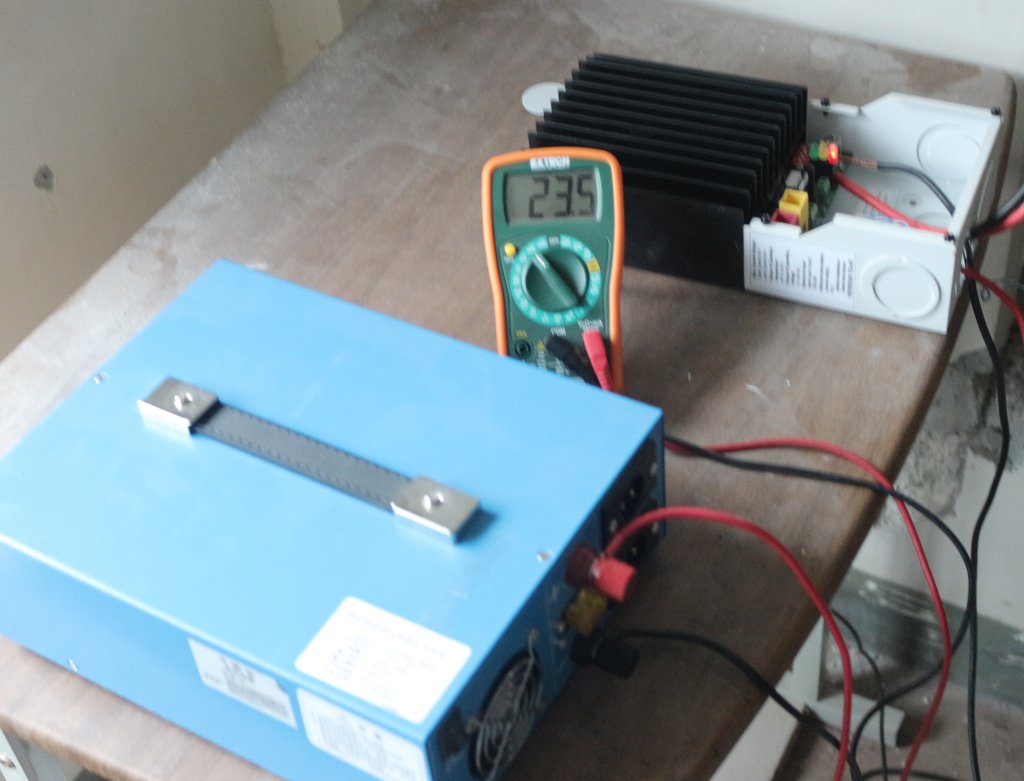
The 45A charge controller (right) and the 600W inverter (left). The voltmeter showing 23.5V across two batteries which means the batteries have low charge.
This got me into thinking that I should be able to see if my setup is charging or discharging the batteries when a load is applied. To do it, I need to be able to measure the current through the wires connected to the batteries and the voltage across the batteries at the same time. After some research, I learned that I need to use a battery monitor that automatically calculates energy going in or out of the batteries. I can do what it does with a voltmeter and some resistors but it might be a pain to take measurements frequently. A battery monitor can also log the numbers thus it is possible to study the performance of the system over a long period.
Budget for my battery monitor is $232 including shipping within the USA. I know someone who is coming home in February from the US so hopefully I will have the money to buy it very soon so he can include it in the box! I hope I can find something like this locally.
Hopefully the sun will be out soon and charge my batteries to 100% so I can start saving money. My current setup will allow me to power a 50W load 24×7 assuming the sun is out most of the day. I will also get an electric meter so I can measure how much energy I have been using for free.
By the way, I am seriously considering 100% solar energy for our office in a few years time because between Dec 2009 and Dec 2013, electricity cost has almost doubled. If the trend continues, by the time I have my solar energy system paid up by my savings, I will have free electricity instead of double of what it costs now.
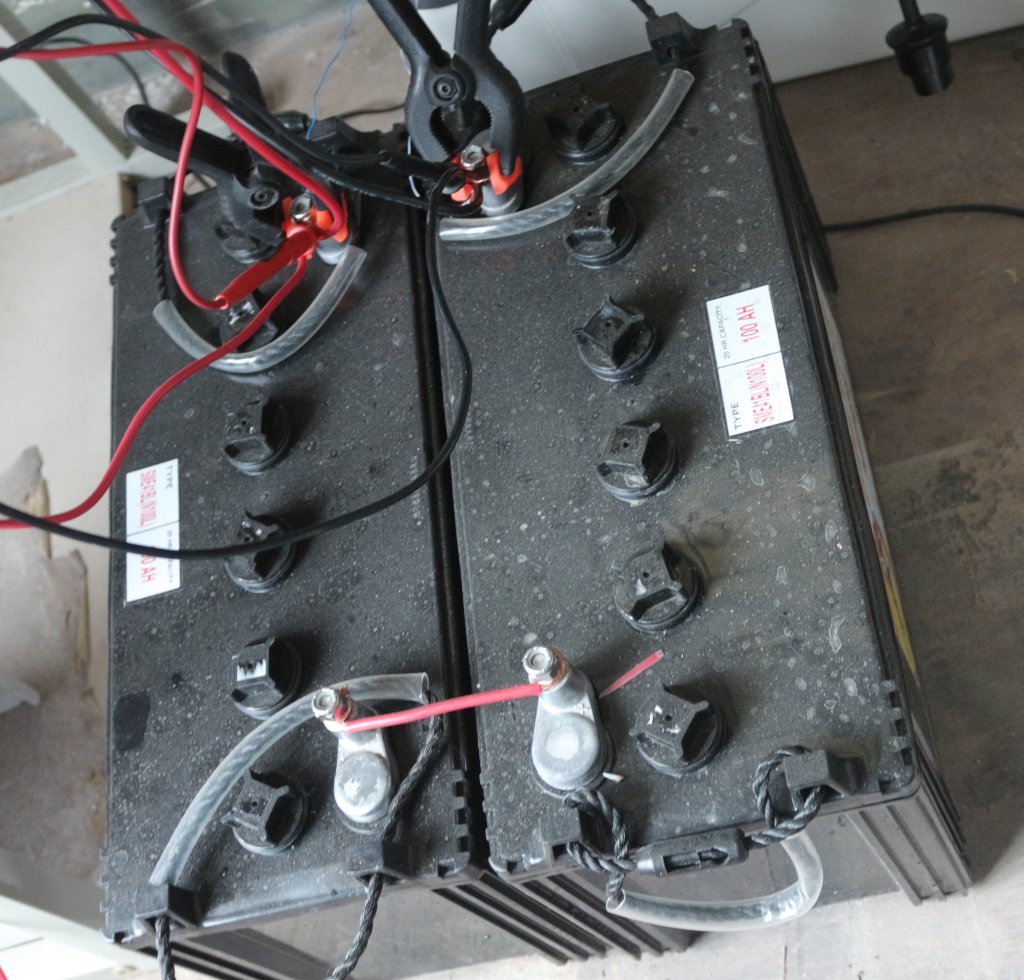
The 24V battery system (2 x 12V batteries in series)
Solar Power Tips
- During cloudy days, a solar power system may work only half its rated capacity or even lower. This is one of the considerations in designing a solar power system. The reduced generating capacity of the panels during cloudy days must be included in the calculations for system capacity. Another option is to design the connections from the inverter such that during cloudy days, part of the load of the solar power system is connected to utility power and switched back to solar again when the sun is out again.
- Solar panels may be connected in series or in parallel or in combination in order to achieve the desired voltage and current required for the system. To increase current, panels are connected in parallel which means the + terminal of one panel is connected to the + terminal of the other panels and – terminals are connected together. To increase voltage, the panels are connected in series which means the + terminal of one panel is connected to the – terminal of another panel. Usually, systems are rated at 12V, 24V or 48V. Four 12V panels connected in series would be needed to power up a 48V system.