
The sun hasn’t been out for almost two weeks now and my batteries are still not fully charged even if it has been charging for a week after I drained it last week. I now must find out why it is taking so long to recharge in cloudy conditions. In theory, my 100W, 24V solar panel should produce 4.1A of charging current during sunny conditions. 4.1A should fully charge my 100AH, 24V battery setup in 24 hours of sunshine which should be just 2 to 3 days.
But because of the the low pressure area (and now a tropical depression), the weather has been cloudy for almost two weeks now. So how much charging is being done in cloudy conditions?
Because I don’t have a battery monitor yet, I just created a make-shift shunt resistor. It is basically a resistor with very low resistance and high current capacity. The smallest resistor I could find was a 0.22ohm, 5W resistor. To measure current, I simply need to get the voltage through a known resistor value and use the equation: I = V/R.
I also don’t want to introduce a large voltage drop between the batteries and the charge controller and inverter because it would affect charging. I expect to measure about 5A of current and the voltage drop would be V = IR or 5 * 0.22 = 1.1V. This is actually too large. The solution is to connect several resistors in parallel which reduces the resistance. I soldered together eight 0.22 resistors in parallel to get a combined resistance of 27.5mOhm. The voltage drop of 5A across it would be 5A * 27.5mOhm = 0.1375V which is low enough to only have minimal effect on the setup.
Between 0.4A and 0.7A charging current was measured at about 4PM. It is less than 20% of the expected current during sunny condition.
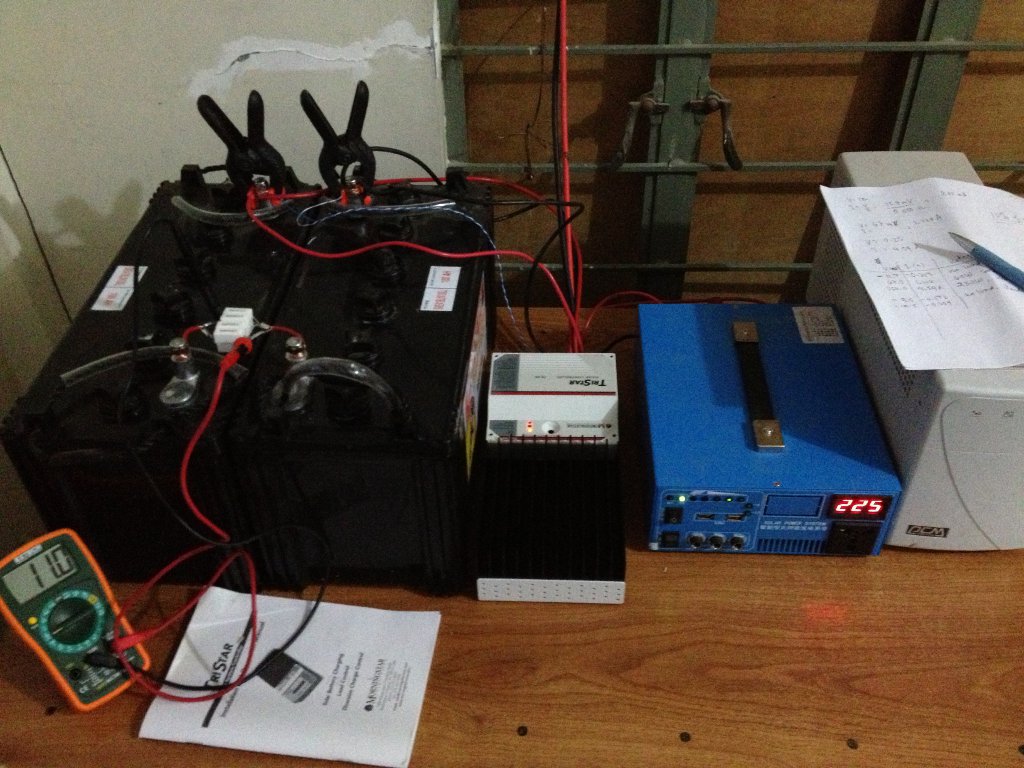
An unused room at the 2nd floor of our office building is gradually transforming into my solar energy laboratory.
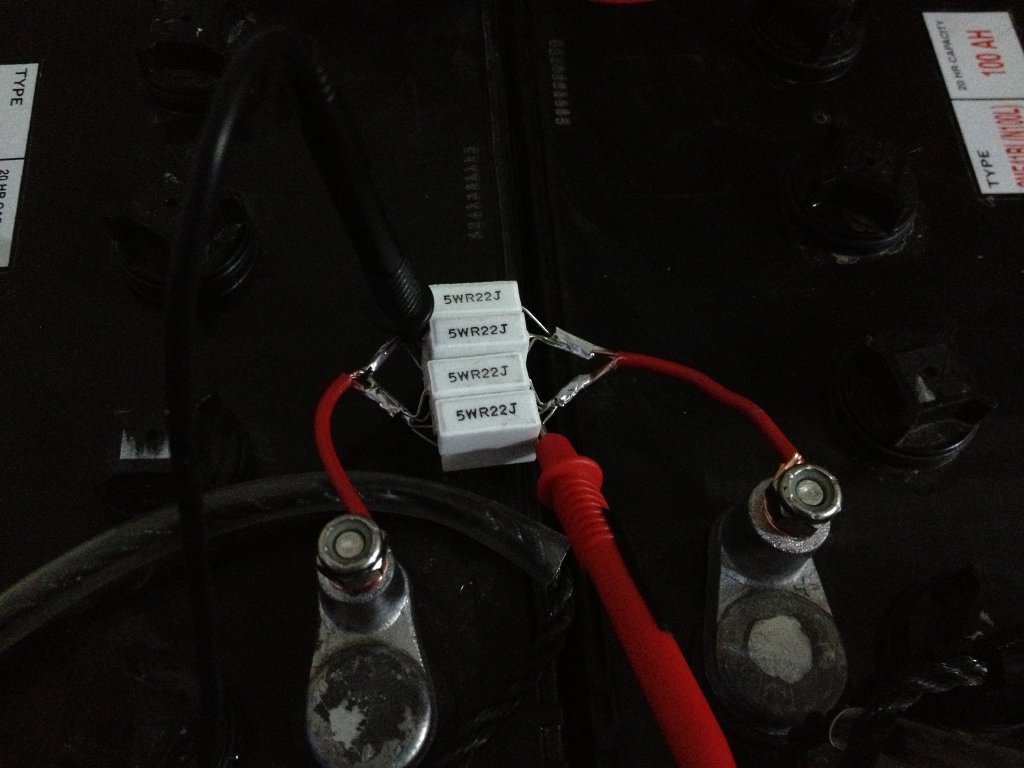
Eight 0.22ohm resistors in parallel becoming a 27.5mohm shunt resistor used for measuring current through the batteries. It is connected between the two 12V batteries because in my setup, this is the most convenient location to put them.
I also measured how much current is coming out of the batteries when a load is introduced. Using the same method above, I turned on the inverter and plugged some known loads. My 60W soldering iron pulled 2.4A while my 230W network equipment pulled 9.08A. If you do the math, 2.4A x 24V = 57.6W and 9.08 * 24 = 217.92W, both of which are close to the known power consumption in AC voltage. This reinforces the fact that the power supplied by the batteries is the same as the power that is converted to 220V AC by the inverter.
What’s left to do now is to wait for the sun to come up and measure the charging current. That way, I can determine for sure how much load I can put on my system for 24/7 operation giving allowance for cloudy conditions.
Solar Power Tips
- Because of the initial cost of a solar energy system may be prohibitive, one can start saving electricity cost by replacing inefficient appliances with modern, high efficiency ones. An example for this are airconditioners. Old, window type airconditioners tend to be inefficient because the compressor is at full capacity whenever it runs. Newer airconditioners use the “Inverter” technology which is quite efficient because the compressor can adjust capacity as needed. Incandescent lamps are very inefficient because it generates a lot of heat to produce light. CFL and LED lights are much more efficient in converting electricity to light.
- If a room is airconditioned, make sure it has good insulation such that radiated heat from the sun will not penetrate the room. Make sure also that the room has good “seal” meaning the cold air should not easily escape from the room. Make sure also the lighting and appliances inside the room do not produce a lot of heat. CRT monitors for computers generate a lot of heat so it makes the airconditioner work harder.