
It might just be coincidence, but I think Mother Nature has a sense of humor. Last week, I said that I will start saving money at Auza.Net by putting our perimeter lights on the solar system. The days following that “historic” day for Auza.Net were cloudy and of course, my solar panel system soon ran out of stored energy after just two and a half nights. Just the same, I saved a few kilowatt-hours and maybe about Php30.00.
That also got me into thinking that my assumptions on how much energy is actually produced and stored could be wrong. I should really need to understand the dynamics of the energy production in relation to the weather for a successful solar energy system. Fortunately, my battery monitor which was purchased in the US arrived late last week and after I installed it on the system, I am able to conveniently measure voltage, current and the battery state of charge.

The battery monitor showing 4.5A of current charging the batteries.
The key item in the installation of the battery monitor is the shunt resistor (with 500A/50mV rating) which is a precision resistor designed for accurate measurement of current going through it. This replaced my home made shunt resistor described in an article a few weeks back. Also, I placed this shunt resistor at the negative terminal instead of in-between the two batteries since the battery monitor also measures the total voltage of the battery which it cannot do if the shunt resistor is placed elsewhere.
One might ask why I am going through the trouble of accurately measuring current and voltage. Why not just buy a large solar energy system and over produce energy so that there would be enough power even if the weather condition is not ideal? The reason is that a large solar energy system can be way out of budget for most people. If my experiments can help people to decide on the affordable capacity of the system they would setup for themselves, then it would be worth the trouble. Besides, an engineer like myself would really like to see the numbers and the details.

The 500A/50mV shunt resistor used to accurately measure current flowing in or out of the batteries.
Because I still only have a 128W solar panel, energy production is still quite small and the need to squeeze out all the energy that can be produced is important. So I re-installed my solar panel with a 30 degree angle facing south, the recommended placement for maximum solar energy conversion. Just this simple change increased the system’s charging current by about 25%. This is very important to take note because a horizontally installed panel is not as efficient. The energy production improved because by tilting the panel this way, it faces the sun more directly throughout the day, thus maximizing energy production.
You will note that my solar panel is different from the usual solar panels that you may have seen. I am using a flexible, thin film solar panel which is easier to transport because you can roll it but much more complicated to install because you need to have a frame or a flat roof. For now, I am using a temporary frame constructed from coco lumber. This will change when I am decided on how to install this panel and the additional panels on the roof deck.
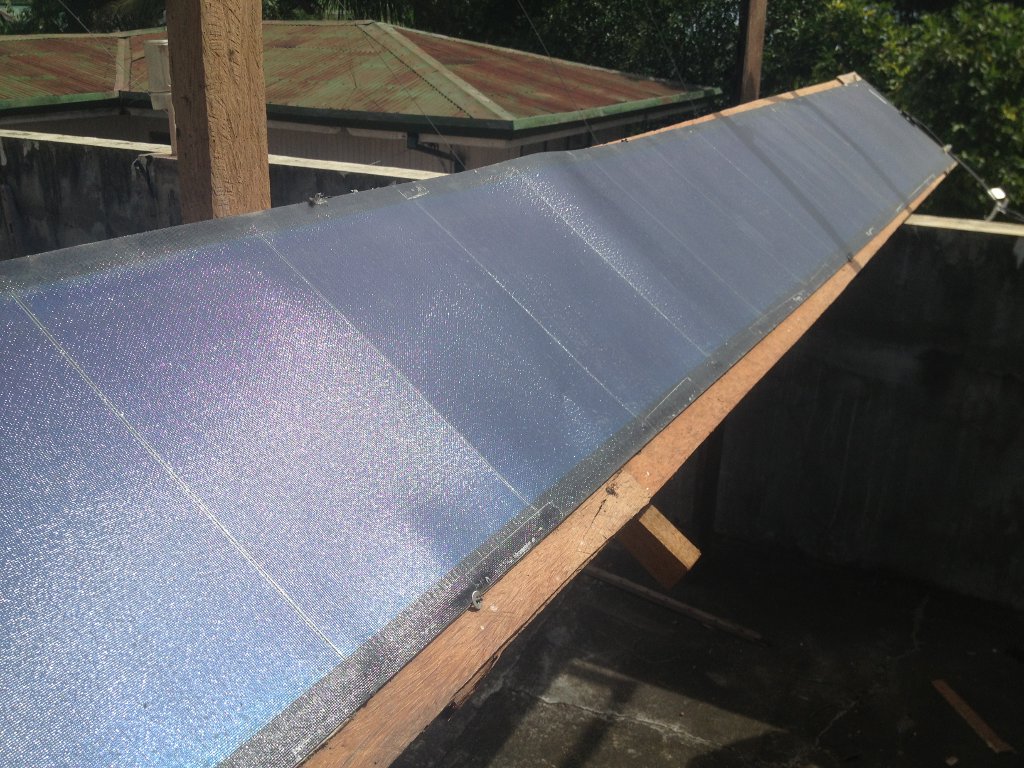
Flexible thin-film solar panel installed on a temporary frame. The 30 degree angle improved output by about 25% compared to when it was installed horizontally.
At this time, I just really need to add more panels and gather data. I have found a source for 300W, 24V solar panels that cost Php30,000 each. Buying larger panels will be more cost effective because the cost per watt is lower versus buying smaller panels. For example, the 100W panels I had bought in the past cost about Php12,000 to Php15,000.
I am actively looking for sponsors and benefactors who will help me acquire a total of six 300W panels to complete my 1.8kW system (originally planned for 2kW but the charge controller manufacturer suggests that maximum production of the solar panels should only be at 85% of the rated capacity of the charge controller in order to allow for varying conditions). If you wish to help me complete my experiments, please email me at jerome.auza@auza.net. All knowledge gained from these experiments will be published on the Bohol Chronicle and on the Auza.Net website to help encourage use of renewable energy.
By the way, we had two 1-hour power interruptions Saturday, so instead of running the generator, I used the solar system to power up the network equipment at the office. Fuel cost per hour is about Php100 so that means, total savings last week is about Php230.
—————-
Solar Energy Tips
- When planning to use a solar energy system, consider the proper placement of the solar panel to maximize energy production. Put the panels at an area where there is no shadow throughout the day, ideally at the roof. For maximum energy production, the panels must face south and tilted at an angle of 30 degrees. This makes the panel face the sun more directly throughout the day versus horizontal placement.
- Buy the largest panels possible. The cost per watt is generally lower for large panels. Of course, you need to consider shipping costs and restrictions for the very large panels.
- Start using a solar energy system as soon as you can afford it and utilize it to save on electricity cost. Plan for a system that will be capable of running the most important loads, like lighting, refrigeration, radio, Internet and maybe television. The earlier you start, the earlier you save. And because of the rising cost of electricty, your return on investment from the savings may be quicker than my previous calculation of 4 to 5 years. Electricity cost could double at that time, but you will have free electricity.